Three Consecutive Square-Free Integers, Infinitely Often
A positive integer is square-free if it is not divisible by the square of any prime. Call a positive integer $a$ simple if
\[a,\qquad a+1,\qquad a+2\]are all square-free.
Are there infinitely many simple integers?
The answer is yes, and there is a short proof using only the density of the square-free integers.
This argument was originally written in December 2022 and published here in August 2026.
The proof
Any triple of three consecutive square-free integers must be of the form
\[4n+1,\qquad 4n+2,\qquad 4n+3.\]Indeed, every other triple of three consecutive integers contains a multiple of $4$, which cannot be square-free.
Suppose, for contradiction, that only finitely many of these triples are entirely square-free. Then, for every sufficiently large $n$, at least one of
\[4n+1,\qquad 4n+2,\qquad 4n+3\]is not square-free.
The integer $4n$ is also not square-free. Therefore, every sufficiently large block
\[\{4n,4n+1,4n+2,4n+3\}\]contains at most two square-free integers.
Let $Q(x)$ denote the number of square-free positive integers not exceeding $x$. Our assumption would imply
\[Q(x)\leq \frac{x}{2}+O(1).\]However, the square-free integers have natural density
\[\lim_{x\to\infty}\frac{Q(x)}{x} = \frac{6}{\pi^2} > \frac12.\]This is a contradiction. Hence there are infinitely many triples of consecutive square-free integers. (\square)
A quantitative consequence
The same proof gives more than infinitude.
Let $G(N)$ be the number of $n\in{0,\ldots,N-1}$ such that
\[4n+1,\qquad 4n+2,\qquad 4n+3\]are all square-free.
A good block contains three square-free integers, while every other block contains at most two. Consequently,
\[Q(4N)\leq 2N+G(N).\]Since
\[Q(4N)=\frac{24}{\pi^2}N+o(N),\]we obtain
\[\liminf_{N\to\infty}\frac{G(N)}{N} \geq \frac{24}{\pi^2}-2 \approx 0.4317.\]Thus the proof actually establishes that such triples have positive lower density among the possible triples ((4n+1,4n+2,4n+3)).
The original note
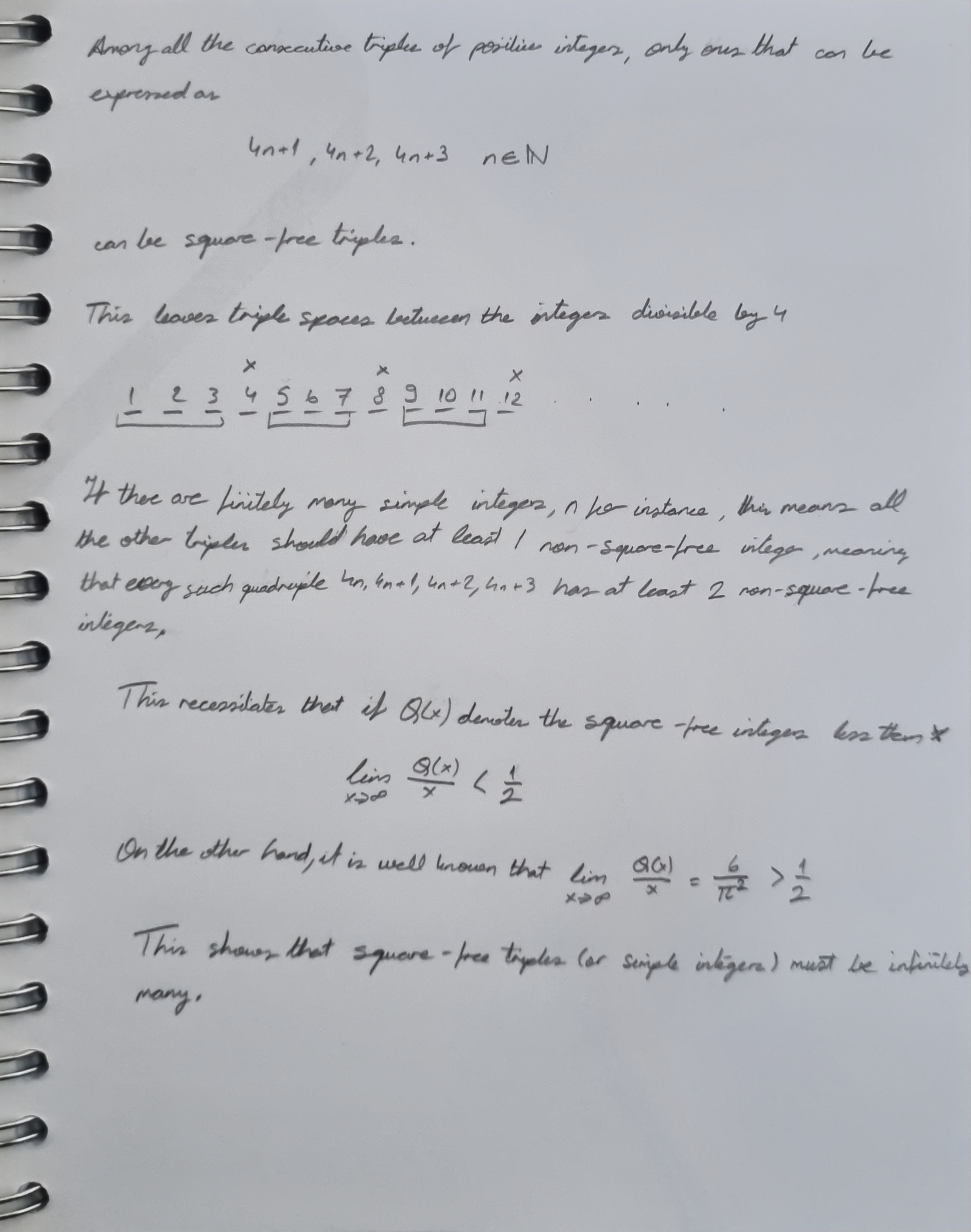
I found this argument in December 2022 while solving Bilkent University’s Problem of the Month. The photograph below is my original handwritten solution from that time.
Note on priority
I found this argument independently, but the result and the proof are not new. Essentially the same density argument had appeared previously, and substantially stronger asymptotic results on patterns of square-free integers are classical.
References
- MathOverflow: Are there infinitely many triples of consecutive square-free integers?
- Bilkent Problem of the Month, December 2022
- Leon Mirsky, “Arithmetical Pattern Problems Relating to Divisibility by (r)th Powers.”